
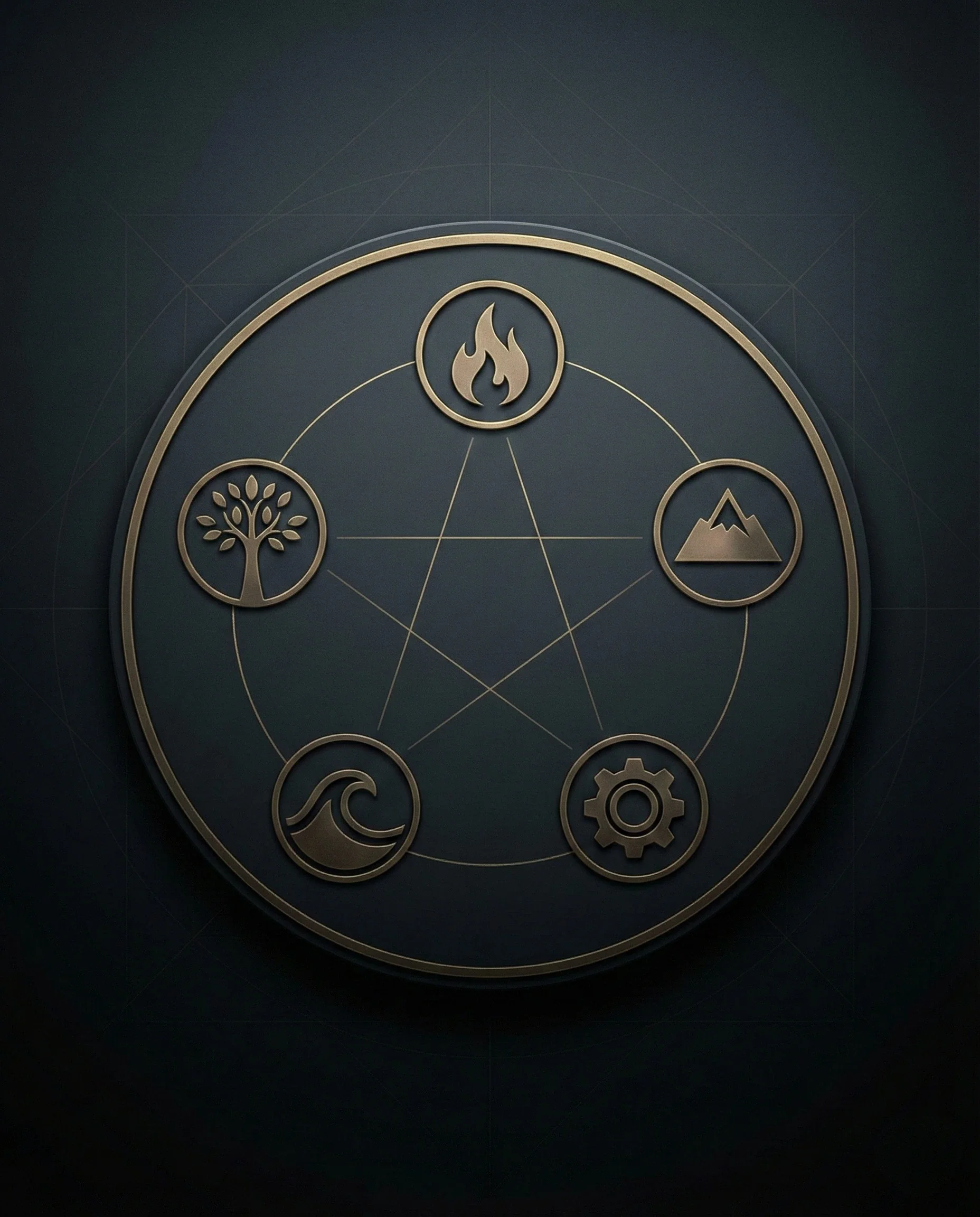
Clinical Applications of Five Phases
Stop Memorizing Correspondences. Learn to Read Pathology.
Most practitioners can recite the Five Phase chart. Wood governs Liver. Fire governs Heart. Metal governs Lung. But recitation is not diagnosis — and a chart on a wall does not tell you which cycle has broken down, which organ is driving the pattern, or where to needle first. Mark Kuebel, L.Ac. teaches you to use the Five Phases the way they were designed: as a dynamic map of how organs generate, regulate, and destroy each other — and what to do when they don't.
The Five Phases Were Never Meant to Be a Chart
The Five Phase system is one of the most powerful diagnostic frameworks in Chinese medicine. It predicts how pathology spreads, explains multi-organ presentations, and gives you a treatment strategy — not just a point list. But that's not how it gets taught. Students leave school knowing the correspondences. They don't leave knowing how to reason through a case.
Mark Kuebel has spent decades working with the classical sources — Claude Larre, Rochat de la Vallée, Dennis Willmont — stripping away the modern simplifications that reduced the Five Phases to a memorization exercise. What he found underneath is a clinically precise system capable of explaining everything from gallstones to insomnia to treatment-resistant emotional illness.
This course transfers that clinical reasoning directly to you.
The Five Phases don't describe what things are. They describe what things do to each other. That's the difference between a chart and a clinical tool.
— Mark Kuebel, L.Ac.Wood/Liver, Fire/Heart, Metal/Lung. You know the chart. But when your patient's presentation crosses three phases at once, the chart gives you no next step.
Shēng, Kè, or Wǔ — the generating, restraining, and rebellion cycles each produce different pathology and require different treatment strategies. Most practitioners can't distinguish them from intake alone.
Learn to identify which cycle has gone awry, trace the root organ driving the pattern, and build a coherent treatment strategy using transport points, herbal formulas, and phase-specific logic.
Course Curriculum
A clinical reasoning course. You will finish with a working framework for reading Five Phase pathology — the three cycles, how they break down, and how to restore balance using acupuncture and herbal medicine.
The Three Cycles: Shēng, Kè, and Wǔ
The generating, restraining, and rebellion cycles — how they interact in health and what happens when each one breaks down. Why excess and deficiency are symptoms, not root causes.
Reading Cyclic Breakdown from Intake
How to use tongue observation, pulse palpation, and symptom questioning to identify which cycle has gone awry. Multi-organ presentations decoded through phase logic.
Case A: Metal Excess Driving Multi-Phase Pathology
A patient presentation spanning Metal over-restraining Wood, Soil exhaustion, and Water starvation. Full diagnosis, treatment strategy, and acupuncture point selection with rationale.
Case B: Soil Exhaustion and Empty Fire
Chronic insomnia from Soil depletion drawing on Fire. Why it's an Empty pattern, not a Full one — and why the treatment approach is completely different. Point selection, herbal formulas, and moxa strategy.
Transport Points and Five Phase Designations
How to use Hand and Foot Shū points with their Five Phase designations to restore cyclic flow. The logic behind moving Qì between phases without chasing symptoms.
Herbal Formulas for Phase Restoration
Yī Guàn Jiān, Guī Pí Tāng, and classical formula logic applied to Five Phase patterns. How to integrate herbal strategy with acupuncture treatment for compounded clinical effect.

This Course Is Built For Practitioners Who Are Ready
Licensed Acupuncturists Who Diagnose but Don't Quite Know Why
You can identify Liver Qi stagnation. You can treat it. But when the pattern involves three organs and keeps coming back, you don't have a framework for why — or what to do differently. This course gives you that framework.
Licensed PractitionerStudents and Recent Graduates Building Clinical Reasoning
The Five Phases are part of every licensing exam. But the exam tests recall, not reasoning. This course teaches you to use what you already memorized — to actually think through a case from intake to strategy.
Student / New GraduatePractitioners Working with Complex or Treatment-Resistant Cases
When standard protocols stop working, phase dynamics often explain why. Rebellion and insulting cycles underlie the most stubborn patterns — emotional illness, psychosomatic presentations, multi-system dysfunction. This course equips you to see them.
Complex Case PractitionerYou are looking for a passive, box-checking CEU experience. This course requires clinical engagement. A brief assessment is required to earn your PDA credit — because competence, not completion, is the standard.
Senior Lecturer:
Classical Systems & Herbology
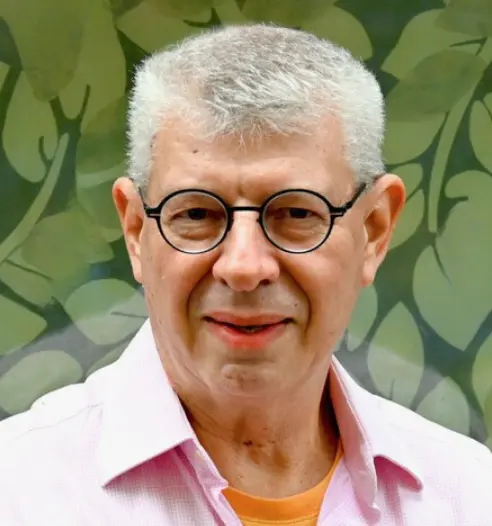
Mark Kuebel, L.Ac.
Mark Kuebel represents the intellectual spine of the Guild. With a background in biological sciences and decades of rigorous study in Classical Chinese Medicine, his approach to pain management is structural and physiological — not mystical.
His primary influences include Claude Larre, S.J., Elisabeth Rochat de la Vallée, and Dennis Willmont, L.Ac. Before entering clinical practice, he spent nine years consulting for an AIDS buyer's club — an experience that permanently grounded his work in patient-centered, outcome-driven thinking. He is currently writing a textbook on the foundational updates of Chinese medicine.
Mark's teaching mission is singular: strip away the modern simplifications, restore the potency of the original lineage, and give practitioners tools that hold up under clinical pressure.
Clinical Focus-
→
Master Tung Acupuncture: Teaching the internal logic of the system — moving beyond "magic points" into structural and physiological thinking.
-
→
Classical Translation: Updating the foundations of Chinese medicine by integrating new scholarship now available in English.
-
→
Herbal Medicine: Deep scholarship in formula architecture, modification, and the clinical application of classical texts.
Everything You Need to Know Before You Enroll
| Credits | 2 NCCAOM PDA Points — AOM-OM category |
| Format | On-demand video — watch at your own pace, any device |
| Access | Lifetime access upon purchase — no expiration |
| Assessment | Brief clinical quiz required to earn PDA credit — retake as needed until you pass |
| Certificate | Downloadable PDA certificate issued immediately upon passing |
| Reporting | Completed credits reported promptly to the NCCAOM on your behalf |
| Provider | American Acupuncture Guild — NCCAOM Registered PDA Provider |
| Price | $50 — one-time purchase, no subscription required |
Most states accept NCCAOM PDA points toward license renewal. We recommend confirming jurisdiction-specific requirements with your state acupuncture board.
Clinical Applications of Five Phases
Taught by Mark Kuebel, L.Ac.
Instant access after purchase. Secure checkout.
NCCAOM Registered PDA ProviderMore From the Guild Curriculum
 Foundations
Foundations of Chinese Medicine
The cultural and philosophical foundations that shaped the practice of Dào, Qì, and lineage. Essential grounding for every system you study afterward.
 Clinical Skills
Introduction to Master Tung's Acupuncture
Stop using Tung points as a magic list. Learn the six correspondence relationships that govern every point in the system — and start thinking, not memorizing.
 Clinical Skills
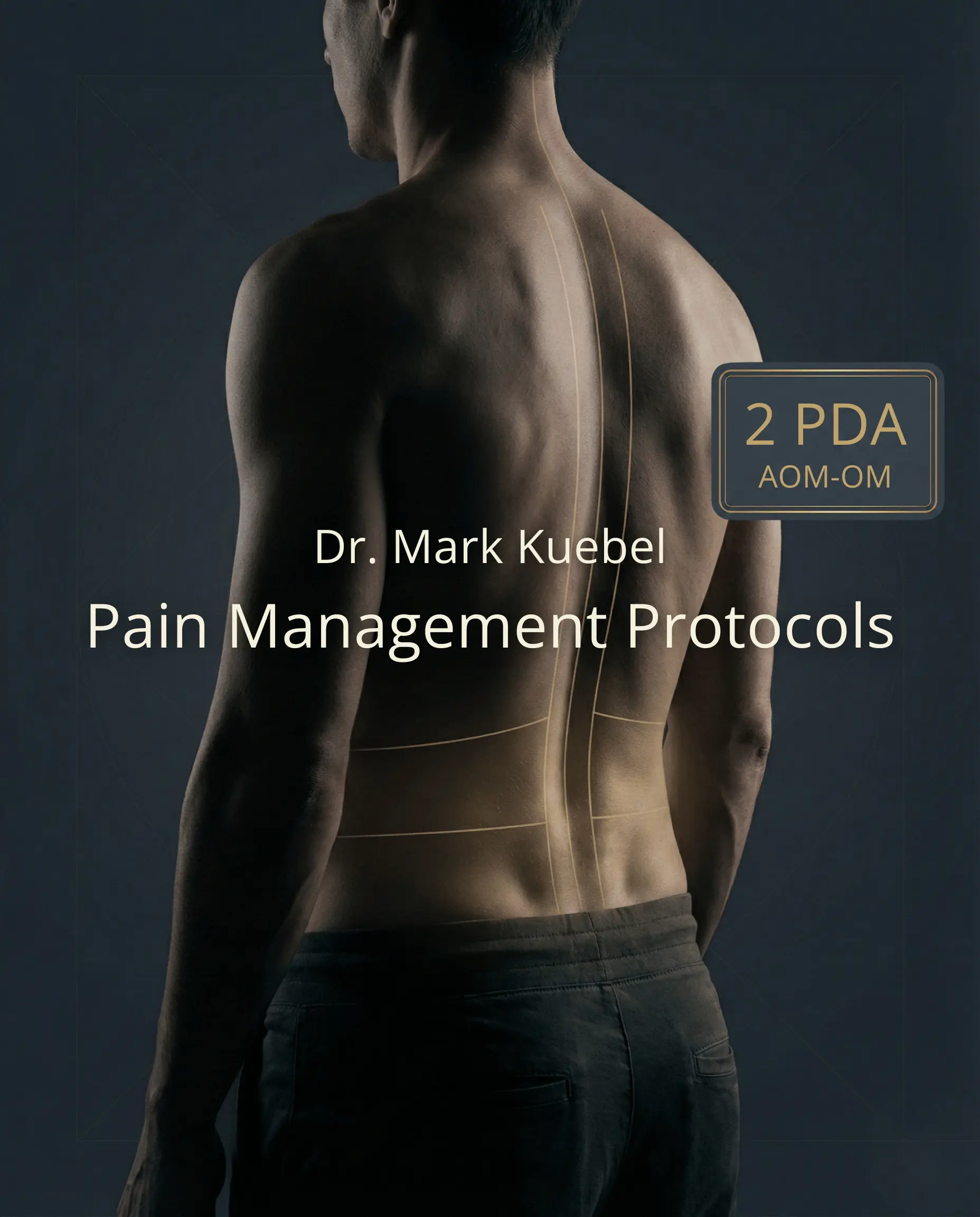
Pain Management Protocols
A rigorous channel-based approach to structural pain. Stop relying on clinical guesswork — master the systematic framework for consistent, replicable results.
10+ courses available across all clinical disciplines.